Rabbits
Housing
Rabbits are very active pets, so a hutch should have enough space
for them to stand up on their back legs and hop three or four times
in each direction. Hutches and runs should ideally be placed out
of the sun and sheltered from the rain and ideally hutches should
be raised off the ground. In the winter, the hutch must be moved
into a garage or outhouse.
Bedding
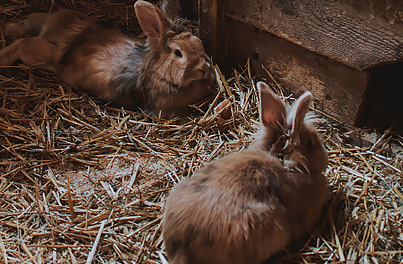
Straw or wood shavings are ideal for rabbits in outdoor hutches
and wet bedding should be removed on a daily basis. Hutches should
be completely stripped out and scrubbed ideally once a week during
the summer and more regularly during the winter when rabbits spend
more time inside.
Blankets or towels are good bedding for litter-trained house rabbits.
House rabbits
House rabbits are gaining in popularity and make great indoor pets.
They should be provided with their own indoor cage, a litter tray
full of cat litter and food and water should be easily accessible.
It's also advisable to remove items from a rabbit's reach such as
indoor plants and electrical cables so that they don't chew them.
Nutrition
Rabbits need fibre rich diets, such as hay or grass, to help digest
food and maintain healthy teeth. Hay and grass should be supplemented
with a complete food, which provides all the nutrients in the correct
amounts and proportions. Rabbits can also be given fresh vegetables,
in moderation. To make the most out of nutrients consumed, rabbits
also eat their own caecotrophs (soft faeces). Water must be accessible
at all times and bottles are often easier to keep clean.
Vaccination
Vaccination is the only proven method of protecting rabbits against
potentially life-threatening diseases such as myxomatosis and viral
haemorrhagic disease (VHD). Your vet will be able to advise you
on vaccination and will also carry out a health check to ensure
your pet is in tip top condition.
Internal
parasites
Internal parasites can cause serious damage to rabbits if left untreated.
One particularly nasty one is Encephalitozoon cuniculi (E. cuniculi)
which affects as many as 50 per cent of domestic rabbits. Our vets
or nursing staff will be able to advise you will be able to advise
you on products to treat internal parasites.
Dental
Dental problems are a major health issue for rabbits. Rabbits need
to eat fibre to wear down their continuously growing teeth. If teeth
don't get worn down enough this can cause drooling and lack of appetite.
Your vet will be able to advise you on your pet's teeth.
Nail
clipping
If rabbits' nails grow too long and start curving they can be trimmed,
but avoid cutting the pink bit in the middle of the nail (called
the quick) as this will hurt and bleed if cut. Your vet will be
able to advise you on how to cut your pet's nails.
Neutering
Neutering female rabbits (does) is recommended to help prevent unwanted
litters and behaviour such as nesting, aggression and mood swings.
It's also advisable to neuter male rabbits (bucks) to prevent aggression.
Your vet will be able to advise you on neutering your pet.
Exercise
Regular exercise is also important to keep rabbits fit and prevent
boredom, which could lead to behavioural problems. It's therefore
advisable to exercise pets in an outdoor run, the garden or the
house as often as possible, but ideally for at least four hours
a day.
Grooming
Rabbits will groom both themselves and others, as it's a social
activity. Some long-haired breeds will need daily grooming by their
owners to remove loose and matted hair. You should also check rabbit's
eyes, ears, nose, mouth, bottom and nails daily.
Handling
Techniques for handling rabbits vary depending on their weight and
size. However, it's advisable to always try and pick up a rabbit
with one arm under his bottom to support his weight. Never lift
a rabbit by the ears or by the scruff of the neck. If your rabbit
doesn't like being handled, stroking when feeding will help him
become accustomed to being picked up.
Company
Indoor rabbits can socialise regularly with their owners, so they're
happy to live alone; however it's advisable that an outdoor rabbit
has the company of one or more rabbits to replicate the socialising
that would take place in warrens in the wild.
Regular
Health Checks
Your vet will carry out a 'nose to tail' MOT when your rabbit is
given its booster vaccinations. You can play a role too by following
the guidelines below to keep an eye on your rabbit's health and
help him to stay in tip top condition and live a long and healthy
life:
- Look
out for changes in your rabbit's food consumption, drinking and
toilet habits. Does he have less energy or is he slower in getting
up or jumping? Monitor your rabbit's faeces for colour, consistency
and signs of worms
- Rub
your hands over your rabbit's body including his head, legs and
feet to check for any lumps or bumps or anything stuck in his
pads. Also keep your eyes open for evidence of fleas and other
parasites. Check your rabbit's coat quality and whether any dandruff
or hair loss is evident. Is your rabbit scratching, chewing or
biting excessively?
- Check
your pet's nose, eyes and ears for any abnormalities or discharge.
Your rabbit's nose should be moist, the corners of his eyes should
be free of discharge and his ears should be clean
- Regularly
examine your rabbit's mouth for signs of disease and overgrown
teeth
- Monitor
your rabbit's body condition by running your hands over his ribs
and backbone. If he is losing weight or is overweight, it's advisable
to take him to the vet.
|